When people reach out for therapy after trauma, abuse, bereavement, or suicide loss, they’re often carrying not only pain, but also fear — fear of not being believed, not being understood, or being judged for how they’ve coped. Many have had experiences with services that felt rushed, dismissive, or unsafe. So when they hear the phrase “trauma‑informed support,” it can sound reassuring, but also vague.
What does it actually mean? What should it feel like? And how do you know if a therapist is truly working in a trauma‑informed way?
At Phoenix Counselling 1814, trauma‑informed support isn’t a buzzword. It’s the foundation of everything I do. Here’s what that looks like in practice.
1. Safety comes first — always
Trauma affects the nervous system, the body, and a person’s sense of safety in the world. A trauma‑informed space recognises this and prioritises emotional, physical, and cultural safety from the very first interaction.
This means:
- You are not pushed to share anything before you’re ready
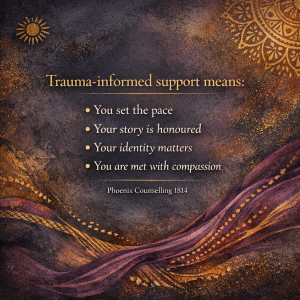
- You set the pace
- You have choice and control at every step
- Your boundaries are respected without question
Safety isn’t created by soft lighting or calm colours — it’s created by how you are treated.
2. Your story is honoured, not interrogated
Trauma‑informed support understands that survivors are the experts in their own experiences. You will never be asked to “prove” your trauma or justify your reactions.
Instead, the focus is on:
- Listening deeply
- Believing you
- Understanding the context of your experiences
- Supporting you without judgement
Your story is held with care, dignity, and respect.
3. Your identity and culture matter
Trauma does not happen in a vacuum. It is shaped by identity, culture, community, and systems of power. Trauma‑informed support must also be culturally responsive.
This means acknowledging:
- The impact of racism, discrimination, and oppression
- How culture shapes grief, trauma, and healing
- The ways systems can harm as much as they help
Your identity is not an “add‑on” — it is central to how we work together.
4. We work collaboratively, not hierarchically
Traditional models of therapy can sometimes feel like the therapist is the expert and the client is the problem to be solved. Trauma‑informed practice rejects that dynamic.
Instead:
- We make decisions together
- You choose what feels right for you
- Your voice leads the process
- Therapy is a partnership, not a prescription
You are not a passive recipient of support — you are an active participant in your healing.
5. We focus on your strengths, not your “symptoms”
Trauma responses are not signs of weakness — they are signs of survival. A trauma‑informed approach recognises the intelligence of the body and mind in protecting you.
Together, we explore:
- What helped you survive
- What still serves you
- What no longer feels helpful
- What new tools you might want to build
Healing is not about “fixing” you — it’s about supporting you to live with more ease, safety, and self‑connection.
6. You are never rushed
Trauma healing is not linear. Some weeks you may feel ready to explore difficult memories; other weeks you may need grounding, stabilisation, or simply a space to breathe.
A trauma‑informed space adapts to your needs, not the other way around.
7. You are met with compassion, not judgement
Whether you’re navigating trauma, abuse, grief, or suicide bereavement, you deserve support that meets you with humanity and care.
Trauma‑informed support means:
- No shaming
- No minimising
- No assumptions
- No pressure to “move on”
You are allowed to take up space exactly as you are.
If you’re considering therapy
Trauma‑informed support is not a technique — it is a way of being with people. It is grounded in safety, dignity, collaboration, and deep respect for the complexity of human experience.
Phoenix Counselling 1814 offers specialist support for:
- Trauma & complex trauma
- All forms of abuse
- Bereavement & grief
- Suicide bereavement
If you feel ready, you’re welcome to reach out for a consultation. You don’t have to navigate this alone.